


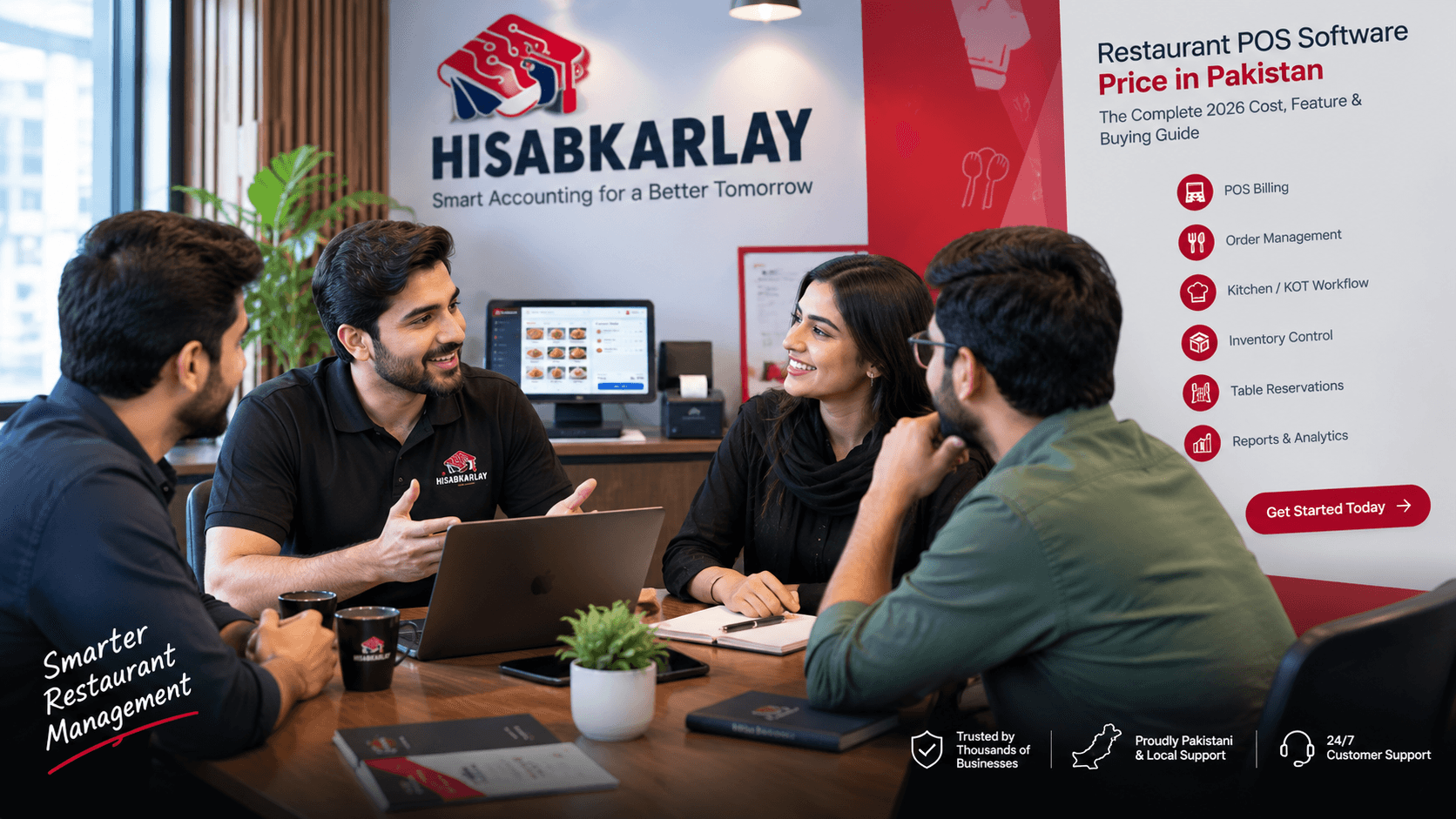

Restaurant POS Software Price in Pakistan: The Complete 2026 Cost & Feature Buying Guide
If you've ever stood behind a counter during a Friday dinner rush while your cashier scribbles orders on a notepad, you already know why so many restaurant owners across Lahore, Karachi, and Islamabad are hunting for the right restaurant POS software price in Pakistan before they commit to anything. It's a bit like buying a car the sticker price never tells you the whole story, because fuel, maintenance, and insurance all creep in later. The same is true for point-of-sale systems built for restaurants, cafes, and fast-food counters. Some vendors quote a flat monthly number, others tack on per-terminal charges, and a few still sell one-time licenses that look cheap until you realize updates and support cost extra every single year. This guide walks through exactly what you should expect to pay in 2026, what actually changes the price, and which features are genuinely worth the extra rupees rather than just marketing fluff dressed up as innovation.
Pakistan's food and retail scene has changed dramatically over the last few years, and honestly, the pressure isn't just coming from customers who now expect faster service — it's coming from the Federal Board of Revenue too. Between digital invoicing mandates, rising rents, and thinner margins, restaurant owners can't afford to guess when it comes to software spending. So before you sign up for the first "affordable" plan a salesperson pitches you, it helps to understand the real cost structure behind restaurant management software Pakistan vendors are selling, and how that price connects to features you'll actually use every single shift.
What Decides the Price of Restaurant POS Software in Pakistan?
Here's the thing nobody tells you upfront: two restaurants ordering what looks like "the same POS system" can end up paying wildly different amounts, and it's rarely because one negotiated better. Pricing for billing software Pakistan vendors offer depends on a handful of variables that stack on top of each other, and understanding them before you shop saves you from sticker shock later. Think of it less like buying a fixed product and more like ordering a meal with add-ons — the base plate is cheap, but every extra topping (extra terminal, extra branch, extra printer integration) adds to the bill. Once you know what's actually driving the number on the invoice, you can negotiate smarter and avoid paying for capacity you'll never use.
Business Size and Number of Branches
A single dhaba with one counter and three staff members has completely different software needs than a five-branch fast-food chain trying to synchronize inventory across the city. Vendors typically price per branch or per terminal, which means a restaurant management system price quote for a solo cafe owner in Faisalabad will look nothing like the quote handed to a chain with outlets in three different cities. Some providers bundle a certain number of users and terminals into a base plan and then charge incrementally for anything beyond that, so a growing business needs to read the fine print carefully rather than just comparing headline numbers. It's genuinely worth asking upfront: does the quoted price include multi-branch reporting, or is that a separate module you'll be asked to purchase six months down the line once you've already committed to the platform?
Cloud vs Offline Billing Systems
This is probably the single biggest price differentiator in the Pakistani market, and it's also where a lot of restaurant owners get burned. Cloud-based systems generally advertise lower upfront costs but depend heavily on a stable internet connection, which — let's be honest — isn't something every neighborhood in Pakistan can guarantee during a power outage or a network glitch. Most POS software in Pakistan costs somewhere between Rs 10,000 and Rs 50,000 per month, with some vendors charging per terminal on top of that base monthly fee, and cloud reliance becomes a real operational risk in areas with inconsistent connectivity. An offline billing app for shop counters or restaurant floors keeps working through outages, which matters enormously during peak hours when a frozen screen means angry customers and lost sales. The trade-off is usually that offline-first systems sync data once connectivity returns, so you're weighing convenience against resilience rather than picking an objectively "better" option.
Hardware Requirements
Software is only half the equation — the physical setup around your counter adds its own chunk to the total bill, and this is where many first-time buyers underestimate their budget. Basic POS machines in Pakistan generally run between PKR 25,000 and 45,000, while more advanced Android-based machines can cost anywhere from PKR 45,000 to 85,000 depending on the brand and included features. On top of the terminal itself, you're looking at thermal printer compatibility for receipts and kitchen tickets, a barcode scanner if you're also selling retail items alongside food, and a cash drawer that integrates cleanly with your chosen software. A separate breakdown found that a basic counter setup typically costs between PKR 25,000 and PKR 90,000 across most Pakistani cities, with thermal receipt printers alone ranging from PKR 12,000 to PKR 35,000. If a vendor's software isn't compatible with the printers or scanners you already own, you may end up replacing perfectly good hardware just to match their proprietary ecosystem — so always ask about peripheral hardware compatibility before signing anything.
Restaurant POS Software Price Ranges in Pakistan
Now that you understand what drives the number, let's actually talk numbers. Pakistan's restaurant POS market in 2026 spans a genuinely wide spectrum, from free trial tools built for solo cafe owners to enterprise-grade systems designed for chains managing dozens of outlets across multiple cities. Rather than throwing around vague "starting from" language the way most vendor websites do, it helps to see the tiers laid out side by side so you can immediately spot where your own business fits. Keep in mind that these numbers shift depending on the rupee's exchange rate against the dollar for internationally-priced platforms, so a plan that felt affordable last year might creep upward simply because of currency movement rather than any change in features.
| Pricing Tier | Typical Monthly Cost (PKR) | Best Suited For |
|---|---|---|
| Budget / Entry-Level | Rs 2,000 – 3,000 | Small cafes, single-counter dhabbas, home-based food businesses |
| Mid-Range / Growth | Rs 5,000 – 9,999 | Single-branch restaurants needing KOT, inventory, and reporting |
| Premium / Enterprise | Rs 8,000+ per branch, scaling with terminals | Multi-branch chains, franchises, cloud-synced operations |
Budget Tier — Small Cafes and Dhabbas
If you're running a small setup a single-counter cafe, a roadside dhaba, or a home kitchen taking phone orders you genuinely don't need every bell and whistle a chain restaurant would pay for. Several offline-ready restaurant POS options in Pakistan now start as low as PKR 2,000 per month, covering the essentials like table management, kitchen printing, and real-time sales reports without demanding an enterprise-level commitment. There's also a growing category of genuinely free POS software, with providers offering extended free trials before converting to a modest monthly fee once you're comfortable with the platform. Some vendors offer trial periods lasting up to 45 days on their web dashboard, including billing, kitchen display, and multi-terminal support with no credit card required upfront. For a business at this scale, the smartest move is picking a plan that covers today's needs without locking you into a long-term contract that penalizes you if your restaurant doesn't survive its first year because let's be honest, that's a real risk every new food business has to plan around.
Mid-Range Tier — Cloud Restaurant POS Pakistan
Once a restaurant graduates past the single-counter stage and starts thinking seriously about repeat customers, staff accountability, and consistent food costing, the mid-range tier becomes the sweet spot. A typical single-branch restaurant in this segment runs around PKR 5,999 per month, which usually includes one terminal, five user accounts, and options to add features like an owner mobile app or a dedicated kitchen display screen. This is also where cloud restaurant POS Pakistan solutions start making real sense, because owners at this stage genuinely want to check daily sales from home or a second location rather than driving to the restaurant every night to review the register. The mid-range tier typically bundles inventory tracking, basic recipe costing, and multi-user staff permissions — features that matter once you have more than one or two employees handling the till. It's worth noting that extra terminals and additional staff accounts beyond the included number are usually billed separately, often around PKR 500 per additional user per month, so growing teams should factor that into their long-term budget rather than being surprised by it later.
Premium Tier — Multi-Branch Restaurant Chains
For restaurant groups running multiple locations, pricing shifts from a flat monthly fee to something closer to a per-branch, per-terminal model that scales with your footprint. Some enterprise-focused platforms list pricing starting around PKR 8,000 per branch per month, and that figure climbs depending on how many terminals, users, and integrations each location requires. At this tier, businesses typically need centralized reporting that consolidates sales across every branch into a single dashboard, automated stock transfers between locations, and role-based access so a branch manager sees different data than head office. International POS platforms priced in dollars can also work at this scale, though converting a typical USD 29 to USD 69 per-terminal fee into rupees usually lands somewhere between PKR 8,000 and PKR 20,000 per month at current exchange rates, and that number tends to rise whenever the rupee weakens against the dollar. Chains evaluating this tier should treat the software decision less like a purchase and more like a long-term infrastructure investment, because switching platforms once you've trained fifty staff members across five branches is genuinely painful.
Must-Have Features Worth Paying For
Price comparisons only tell half the story the real question is what you're actually getting for that monthly fee, because a cheap plan missing a critical feature can cost you far more in lost efficiency than a slightly pricier one that just works. Restaurant owners often get seduced by flashy dashboards during a sales demo, only to discover six months later that the feature they actually needed daily was buried in a higher-priced tier. So let's separate the genuinely useful features from the ones that mostly exist to justify a bigger invoice.
Waiter App and Table Management
Anyone who's dined at a busy restaurant with slow service knows exactly how frustrating it is when an order gets lost between the table and the kitchen. A proper restaurant POS software with waiter app functionality lets staff take orders directly on a handheld device or tablet, sending them straight to the kitchen without a paper ticket ever changing hands. This alone can shave minutes off your average table turnaround time, which matters enormously during peak hours when every extra table you can seat translates directly into revenue. Table management layered on top of this visually mapping which tables are occupied, reserved, or ready for the next party turns your host stand from a guessing game into an actual system, and it's one of the features guests notice even if they never see the software itself.
KOT Printing Billing Software
If you've ever watched a kitchen fall behind because tickets got mixed up or illegible handwriting caused the wrong dish to go out, you already understand why KOT printing billing software exists. Kitchen Order Ticket printing automatically routes each item to the correct kitchen station grill, fryer, dessert counter the moment an order is placed, cutting down on miscommunication between front-of-house and back-of-house staff. This feature becomes especially valuable in larger kitchens with multiple prep stations, where a single shared ticket printer creates bottlenecks and confusion during rush hours. It's a relatively small line item in most pricing plans, but the operational impact is disproportionately large, which is exactly why it shows up as a standard feature even in mid-range restaurant software tiers rather than being locked behind premium pricing.
Recipe Costing Inventory Software
Here's a feature that doesn't get nearly enough attention until a restaurant owner realizes their food cost percentage has quietly crept up without an obvious explanation. Recipe costing inventory software ties every dish on your menu to the exact ingredients and quantities used to make it, automatically deducting stock in real time as orders come through the kitchen. This solves one of the most common and costly problems in Pakistani restaurants: inaccurate real-time inventory deductions that leave owners guessing why their actual stock never matches what the books say it should be. Without this kind of granular tracking, restaurants often discover accounting and inventory mismatches only during a full physical stock count, by which point weeks or months of unexplained shrinkage have already eaten into margins. For any restaurant serious about controlling food costs rather than just estimating them, this feature justifies paying slightly more for a mid-tier plan over the cheapest option available.
HisabKarLay Restaurant POS: Features and Business Benefits
When comparing restaurant POS systems in Pakistan, it is useful to evaluate the actual features offered by each provider rather than relying only on price.
HisabKarLay's published Restaurant Management System information describes a platform for managing customers, orders, and staff roles, including waiter and administrator access. The company also describes online and offline operation, a waiter app, and reporting tools for sales, stock, and profit and loss.
These capabilities may be relevant for restaurants that want to bring several operational tasks into one system.
Online and offline operation
Restaurants can experience internet interruptions, so offline functionality is an important feature to investigate. HisabKarLay states that its restaurant POS supports offline use and synchronizes offline sales with the web POS within an hour.
Before purchasing, ask the company which functions remain available offline, how synchronization conflicts are handled, and whether all devices need an internet connection for normal operation.
Waiter app and staff management
A waiter app can help restaurant employees record orders without relying entirely on handwritten notes or verbal communication. HisabKarLay advertises a waiter app alongside staff roles and order management.
During a demonstration, check how waiter accounts are created, whether staff permissions can be customized, and how orders reach the cashier or kitchen.
Sales, stock, and profit-and-loss reporting
Business reporting helps restaurant owners understand what is happening beyond the billing counter. HisabKarLay describes reporting capabilities for sales, stock, and profit-and-loss analysis.
Ask for a demonstration using sample restaurant data. This will help you understand which reports are available, how frequently information updates, and whether the reports provide the details you need for daily decisions.
FBR Integrated POS System Requirements for Restaurants
Tax compliance has stopped being a background concern for Pakistani restaurants and become a front-and-center operational requirement, and this is genuinely reshaping how much businesses are willing to spend on POS software in 2026. Under a major directive from the Federal Board of Revenue, hotels, restaurants, guest houses, marriage halls, and marquees are now required to integrate POS systems, though facilities without air-conditioning are currently exempted. This isn't a distant regulatory footnote anymore — it's actively changing which software restaurant owners can realistically choose, because a system that can't handle real-time digital invoicing simply isn't viable for a growing number of businesses.
Who Actually Needs FBR Integration
Not every small eatery needs to panic immediately, but the criteria are expanding faster than many owners realize. FBR requires Tier-1 retailers to integrate their points of sale with its IT system, and under the Sales Tax Act, this includes retail outlets of national and international brands, franchises, and businesses operating in air-conditioned malls or plazas. The requirement is gradually expanding to more sectors, including private hospitals and courier services, as newer 2026 rules bring additional industries under the mandate. For restaurants specifically, a Sales Tax General Order issued in 2026 made POS integration mandatory for service providers, with public limited companies exceeding Rs1 billion in annual turnover required to complete registration by a set deadline, while other registered service providers face slightly later compliance timelines. If your restaurant fits any of these categories, delaying integration isn't really a cost-saving strategy anymore — it's a compliance risk with real financial penalties attached.
How FBR Integration Affects Restaurant POS Software Price
Here's where things get interesting from a budgeting perspective: choosing a pre-integrated FBR integrated POS system from the start is almost always cheaper than bolting compliance onto an existing platform later. Costs for FBR POS integration vary depending on the software, hardware, and complexity of the integration involved, but choosing a system that already comes pre-integrated with FBR can significantly reduce those costs compared to manual registration and custom API work. Once properly integrated, every sale is automatically transmitted to FBR in real time, generating a verified invoice with a QR code that customers can check through the FBR Tax Asaan mobile app. For restaurant owners still comparing quotes, it's worth explicitly asking each vendor whether FBR digital invoicing is included in the base subscription or sold as a separate add-on module, because that single question can shift your effective monthly cost by a meaningful margin.
Android Cash Register for Restaurants vs Traditional Hardware
The debate between traditional desktop POS terminals and newer Android-based setups has genuinely shifted in favor of Android in the last couple of years, and it's not hard to see why once you compare the two side by side. An android cash register for restaurants typically costs less upfront, runs on tablets or dedicated Android POS devices, and offers far more portability than a bulky desktop terminal bolted to a countertop. Waiters can carry a tablet table-to-table, kitchens can mount a compact Android screen instead of a full printer setup, and owners can check sales from a phone using the same operating system their staff already understand intuitively. Traditional Windows-based terminals still have their place — particularly for high-volume operations that need more processing power or specific legacy software integrations — but for most small-to-mid-sized Pakistani restaurants, Android hardware delivers comparable functionality at a noticeably lower total cost of ownership, especially once you factor in lower device prices and simpler maintenance requirements.
Fast Food Point of Sale Application Considerations
Fast food operations have fundamentally different needs compared to sit-down restaurants, and a fast food point of sale application built for quick-service environments should reflect that speed-first priority. Where a fine-dining restaurant might prioritize elegant table management and course timing, a fast-food counter cares almost exclusively about transaction speed, order accuracy, and the ability to handle a long queue without the system lagging during peak lunch or dinner rushes. Combo meal customization, quick-tap modifiers for extras or substitutions, and integration with delivery riders waiting at the counter all matter more here than elaborate table maps ever would. Many fast-food operators in Pakistan are also increasingly connecting their in-store systems with delivery platforms, which raises the question of in-store barcode and online checkout integration — essentially making sure a customer's online order and their in-store pickup both hit the same inventory and reporting system rather than existing as two disconnected sales channels that never reconcile with each other at month's end.
How HisabKarLay Fits Into the Restaurant Management System Price Conversation
For restaurant owners weighing all of this against their own budget, HisabKarLay approaches the pricing conversation from a genuinely practical angle rather than a one-size-fits-all package. Instead of forcing every business into an identical plan, the platform structures pricing around what a restaurant actually operates like day to day whether that's a single dine-in location needing solid KOT printing billing software and table management, or a multi-branch fast-food chain that needs centralized reporting across every outlet. The broader business management software Pakistan approach behind the platform also connects billing directly to inventory and recipe costing, which matters if you're tired of your stock counts never quite matching your sales reports. Restaurant owners exploring HisabKarLay's restaurant tools can also look into the platform's AI Poultry Management solution if their supply chain includes farm-to-kitchen sourcing, or its Online Ordering module for restaurants juggling delivery apps alongside walk-in customers — both of which tie back into the same unified reporting dashboard rather than existing as separate, disconnected tools.
Choosing the Right Restaurant Management System Price Plan for Your Business
At the end of the day, picking the right plan isn't about finding the cheapest number on a pricing page — it's about matching software capability to how your restaurant actually operates on a Tuesday afternoon and a Saturday night rush alike. A single-counter cafe owner spending Rs 8,000 a month on enterprise features they'll never touch is just as poorly matched as a five-branch chain trying to squeeze by on a Rs 2,000 budget plan never built for multi-location reporting. Before committing, walk through your actual daily operations: how many terminals do you run, do you need offline resilience during power cuts, does your business fall under FBR's expanding integration requirements, and will you need recipe costing to control food costs as you scale? Getting honest answers to these questions before comparing vendor quotes puts you in a far stronger negotiating position than walking into a sales call cold, and it dramatically reduces the odds you'll be switching platforms in frustration a year from now after outgrowing a plan that looked perfect on paper.
Conclusion
Restaurant POS software pricing in Pakistan isn't a single number you can Google and trust blindly — it's a range shaped by your business size, your hardware choices, your compliance obligations, and the specific features your kitchen and floor staff actually rely on every shift. Whether you're a small dhaba just starting out with a free trial plan or a growing chain evaluating enterprise-grade restaurant management software Pakistan options, the smartest approach is matching your spending to real operational needs rather than chasing the cheapest or most feature-loaded plan on the market. FBR integration, once optional, has become a genuine cost and compliance factor that deserves attention from day one rather than being bolted on as an afterthought. Take the time to map your restaurant's actual daily workflow against what each pricing tier offers, and you'll land on a system that pays for itself in smoother operations rather than sitting there as an expensive line item nobody fully uses.